
Dog Loose Motion: Home Care & When to See a Vet
Why dogs get loose motion, how to care for your dog at home, what to feed, what never to give, and the warning signs (blood, puppies, weakness) that mean a vet visit today. Reviewed by a vet.


Medically reviewed by
BVSc & AH · Karthi's Pet Clinic, DSP Bungalow Road, Adoni · in collaboration with wagNbush
Published 5 min read
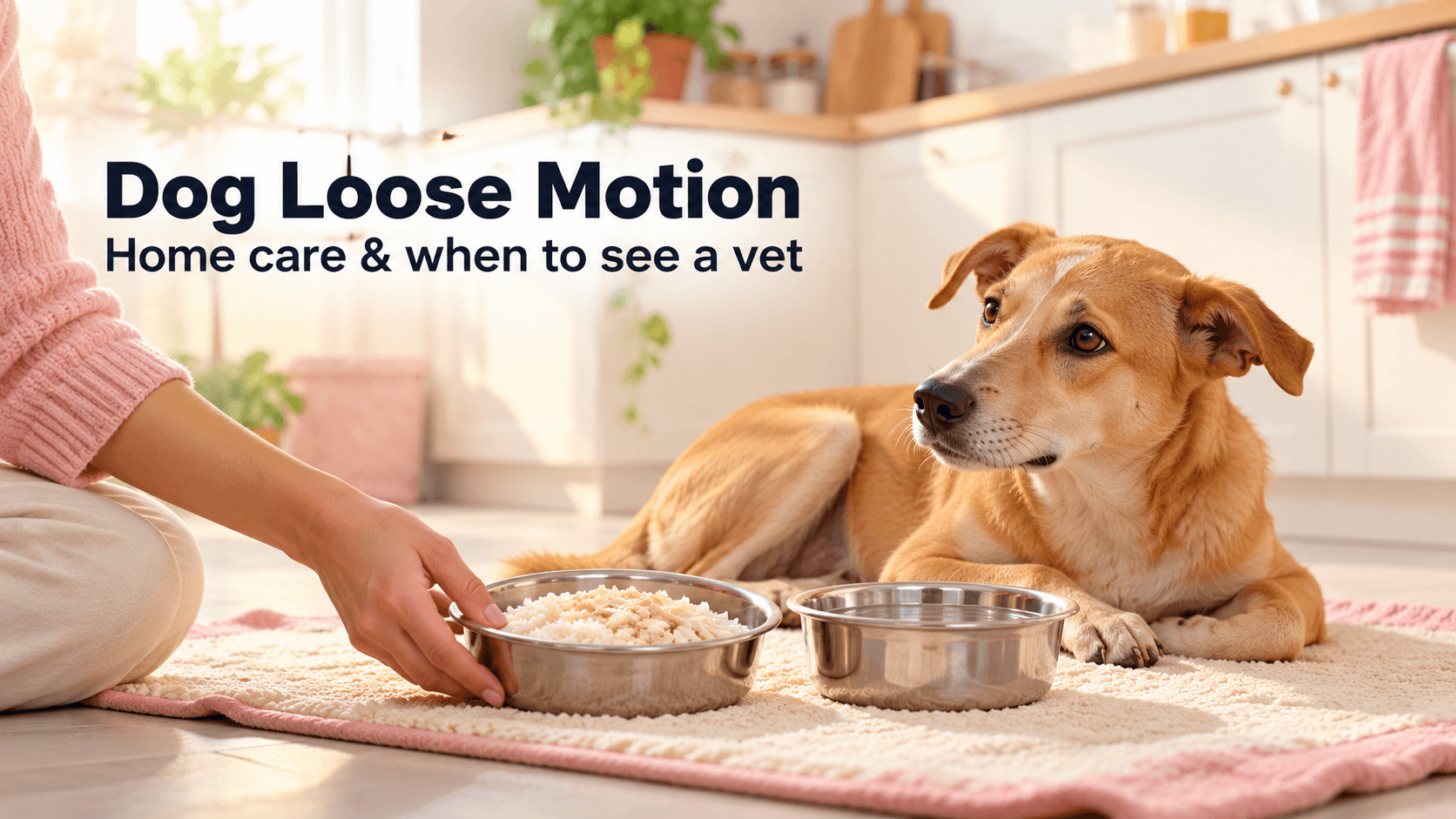
Loose motion is one of the most common reasons Indian pet parents call a vet. Often the cause is simple: a sudden food change, a samosa stolen off the table, or something picked up on a walk. Most mild cases settle in a day or two with rest and bland food.
But loose motion can also be the first sign of parvo, worms, tick fever or poisoning, and puppies and small dogs can become dehydrated within hours. This guide explains how to tell the difference, how to care for your dog at home, and when to stop waiting and see a vet.
What causes loose motion in dogs?
| Common cause | What it looks like |
|---|---|
| Sudden food change | Starts a day or two after a new food or treat |
| Table food and festival leftovers | Oily, spicy or sweet food: biryani, pakoras, mithai, gravy |
| Garbage or scavenging on walks | Comes on suddenly; may come with vomiting |
| Worms | Loose or mucus-covered stool, sometimes visible worms, pot belly in puppies |
| Giardia and other gut parasites | Smelly, greasy, on-and-off loose motion |
| Parvovirus | Puppies: very smelly, often bloody loose motion with vomiting and weakness. Emergency |
| Stress | After boarding, travel, Diwali crackers or a new home |
| Milk | Many adult dogs can't digest milk well |
| Bacterial gut infections | Loose motion, often with fever, low energy or not eating; your vet may test a stool sample |
| Tick fever, poisoning, other illness | Usually with other signs like fever, not eating or weakness |
In Dr C Venkata Narendra's clinic, the most common causes are internal parasites, bacterial infections and sudden diet changes.
What different stools can tell you
- Soft but formed: often a mild diet upset. Watch.
- Watery: higher risk of dehydration. Keep water going and watch closely.
- Mucus (jelly-like coating): often irritation of the large bowel; can be worms or diet.
- Fresh red blood or streaks: irritation of the lower bowel. If it's more than a streak, or repeats, see a vet.
- Black, tarry stool: can mean bleeding higher up in the gut. See a vet today.
- Worms (like rice grains or spaghetti): deworm on your vet's advice.
Taking a photo, or a fresh sample in a clean container, helps your vet.
How to care for your dog at home
For an adult dog with mild loose motion that is still alert and drinking:
- Keep fresh water available all the time. Dehydration is the main danger.
- Rest the gut briefly. For an otherwise active adult dog, a food break of 6–8 hours is fine, with water always available. Never withhold food from puppies, toy breeds, very old or diabetic dogs, or pregnant or nursing dogs.
- Give small bland meals. Plain boiled rice with boiled chicken (no skin, bones, oil, salt or masala) is easy on the stomach. Give small portions 3–4 times a day. Small portions of plain curd rice, or soft khichdi of rice and moong dal with no ghee, salt, onion, garlic or masala, are also fine.
- Go back to normal food slowly over 2–3 days once the stool firms up, mixing a little more of the usual food each day.
- Skip treats, chews and table food until your dog is fully better.
- Note the details: how often, colour, any blood or mucus, and whether your dog is eating.
Probiotics: probiotics made for dogs can help some dogs recover faster. Use one your vet recommends, not human probiotic sachets.
Vet's advice
“Never wait with a puppy. Loose motion with vomiting can be parvo, and puppies get dehydrated within hours, so come the same day. For adult dogs, keep water available, give small bland meals and never give human tablets.”
Dr C Venkata Narendra, BVSc & AH, Karthi's Pet Clinic, AdoniWhat not to give
- No human loose-motion tablets or syrups. Some medicines for people can be harmful to dogs, and the right medicine depends on the cause. Only give what your vet prescribes.
- No painkillers. Paracetamol and ibuprofen-type medicines can poison dogs.
- No milk. It usually makes loose motion worse.
- Don't guess with antibiotics left over from an earlier illness. They may not be the right ones, and wrong use breeds resistant bacteria.
- ORS only if plain and unflavoured, in small sips, for a dog that is drinking and not vomiting. Avoid flavoured or sugar-free electrolyte drinks, because some sweeteners such as xylitol are poisonous to dogs. A weak or vomiting dog, or a puppy, needs a vet rather than ORS at home.
When to see a vet today
Go to a vet the same day, or immediately if marked, when:
- Your dog is a puppy, especially if not fully vaccinated. Loose motion with vomiting in a puppy can be parvo (immediately)
- There is a lot of blood, or the stool is black and tarry (immediately)
- Your dog is also vomiting and can't keep water down
- Your dog is weak, very quiet, or has pale gums
- Your dog has a fever or is not eating
- Your dog may have eaten something poisonous or a foreign object
- Loose motion lasts more than 24–48 hours, or keeps coming back
- Your dog is old, very small, or has other illnesses
- You see signs of dehydration: dry, sticky gums, sunken eyes, or skin on the back of the neck that stays tented when gently pinched
Late at night? Call your nearest 24-hour pet hospital before you leave, so they're ready when you arrive.
What the vet will do
Your vet will check your dog's temperature, hydration and belly, and may suggest:
- a stool test for worms, giardia and other parasites
- a parvo test for puppies
- blood tests if your dog seems unwell
- medicine, and fluids (a drip) if your dog is dehydrated
Typical cost: at Dr C Venkata Narendra's clinic in Adoni, a loose-motion visit usually costs about ₹1,000–1,500, covering consultation, stool test, injections and a drip if needed. Fees vary by city and clinic.
How to prevent loose motion
- Change food slowly, over 5–7 days.
- No table food, sweets or milk. See foods poisonous to dogs.
- Deworm on schedule: dog deworming schedule.
- Vaccinate puppies on time to protect against parvo. Our dog vaccination chart has the full schedule.
- Keep your dog on a short leash near garbage, and teach "leave it".
- Clean water bowls daily, and avoid letting your dog drink from puddles.
- Plan boarding calmly: take your dog's own food along so the diet doesn't change suddenly. Find trusted boarders in Bengaluru and Delhi NCR.
Frequently Asked Questions
What is the best home treatment for dog loose motion?
Keep water available, give small bland meals of plain boiled rice and chicken, and return to normal food slowly. If your dog is a puppy, weak, vomiting or has blood in the stool, see a vet instead.
Which medicine is good for dog loose motion?
The right medicine depends on the cause, so your vet needs to decide. Human loose-motion medicines can be harmful to dogs, so please don't use them.
Is curd good for dogs with loose motion?
Usually yes, in small amounts. Plain, unsweetened curd has much less lactose than milk, and most dogs tolerate it. Start with a spoonful and stop if the loose motion gets worse. Never give milk.
Why does my dog have loose motion with blood?
A small streak of red can come from irritation of the lower bowel. More blood, black stool, or blood with vomiting and weakness can be serious, including parvo in puppies. See a vet today.
How long does loose motion last in dogs?
Mild diet-related loose motion usually improves within 1–2 days. If it lasts longer, keeps coming back, or your dog seems unwell, see a vet.
My dog has loose motion after boarding. Is that normal?
Stress and a change of food can cause mild loose motion for a day or two after boarding. If it lasts longer or your dog seems unwell, see a vet.
Can worms cause loose motion in dogs?
Yes. Worms are a common cause, especially in puppies. Your vet can test a stool sample and choose the right dewormer.
Can I give my dog ORS for loose motion?
Plain, unflavoured ORS in small sips is generally safe for a dog that is drinking and not vomiting. Never use flavoured or sugar-free electrolyte drinks, which can contain xylitol. Puppies and weak or vomiting dogs need a vet.
Are probiotics good for dogs with loose motion?
Probiotics made for dogs can help some dogs recover faster. Use one your vet recommends, not human probiotic sachets.
Sources: MSD Veterinary Manual, diarrhoea in dogs; MSD Veterinary Manual, canine parvovirus; Companion Animal Parasite Council (CAPC), giardia; WSAVA vaccination guidelines. This guide is for general awareness and doesn't replace your vet's advice.
Medically reviewed by
 on wagNbush
Dr C Venkata Narendra
Andhra Pradesh State Veterinary Council, Reg. No. APSVC/05215/2010
- BVSc & AH
- 14 years experience
- Karthi's Pet Clinic, DSP Bungalow Road, Adoni
Dr C Venkata Narendra (BVSc & AH) has 14 years of experience in the dairy sector and 6 years as a small animal clinician. He runs Karthi's Pet Clinic in Adoni, treating dogs, cats and large animals.
Dr C Venkata Narendra checked this article for medical accuracy on 25 October 2026. It is general guidance, not a diagnosis; always ask your own vet about your pet.
Share this feature
Share this article
Related articles
Delhi Air Pollution and Dogs: When to Walk and What to Watch For
What Delhi's winter smog does to dogs, the warning signs, how long to walk at each AQI level, which breeds are most at risk, and how to keep your dog busy indoors. Reviewed by a vet.
Read guideCat Price in India: Breed-Wise Prices, Monthly Costs & Buying Guide
Planning to get a cat in India? Compare 2026 prices for Persian, Siamese and other popular breeds, plus monthly expenses, adoption costs and tips for choosing a cat.
Read guideBooking Software for Pet Businesses in India
Notebook, WhatsApp, a free calendar app or proper pet booking software? What boarders, groomers, walkers, trainers and vet clinics in India actually need, what it costs per month, and how to switch without losing customers.
Read guideReady to Find Pet Services Near You?
Browse verified pet service providers in your city and book instantly on wagNbush.