
Pet First Aid Guide India: Dog Emergencies & Kit List
Pet first aid guide for India: dog first aid kit list, bleeding, choking, poisoning, heatstroke, snake bite, tick paralysis, road accidents, and the signs that mean rush to a vet now.
By the wagNbush Team · Last updated: 17 October 2026 · 13 min read
Emergencies happen fast: a cut paw on a walk, a swallowed rat-poison pellet, a collapse on a hot May afternoon. What you do in the first few minutes, before you reach the vet, really matters.
This pet first aid guide is written for Indian homes and streets. Read it once now, save it, and keep a small kit ready.
Quick answer:
- Stay calm, stay safe, call ahead. A hurt dog may bite, so protect yourself, then phone your vet or nearest 24-hour clinic while someone else helps.
- Bleeding: press a clean cloth firmly on the wound and hold it; do not keep lifting to check.
- Poisoning: do not make your dog vomit unless a vet tells you to; take the packet with you.
- Heatstroke: cool first with plenty of cool (not ice-cold) water and moving air, then go to the vet.
- Snake bite or road accident: keep the dog still, carry them, and go to a vet immediately.
- First aid never replaces a vet. Every emergency needs a vet check, even if your dog seems fine afterwards.
The 3 Golden Rules of Pet First Aid
These apply to every emergency below.
- 1. Stay calm. Your dog reads your energy. A calm voice helps keep them still.
- 2. Keep yourself safe. Even the gentlest dog can bite when in pain. Keep your face away and use a towel or soft muzzle if needed (never muzzle a dog that is vomiting or struggling to breathe).
- 3. Call the vet early. Ring ahead so the clinic is ready when you arrive. Save your vet's number and the nearest 24-hour clinic in your phone today.
Dog First Aid Kit List for India
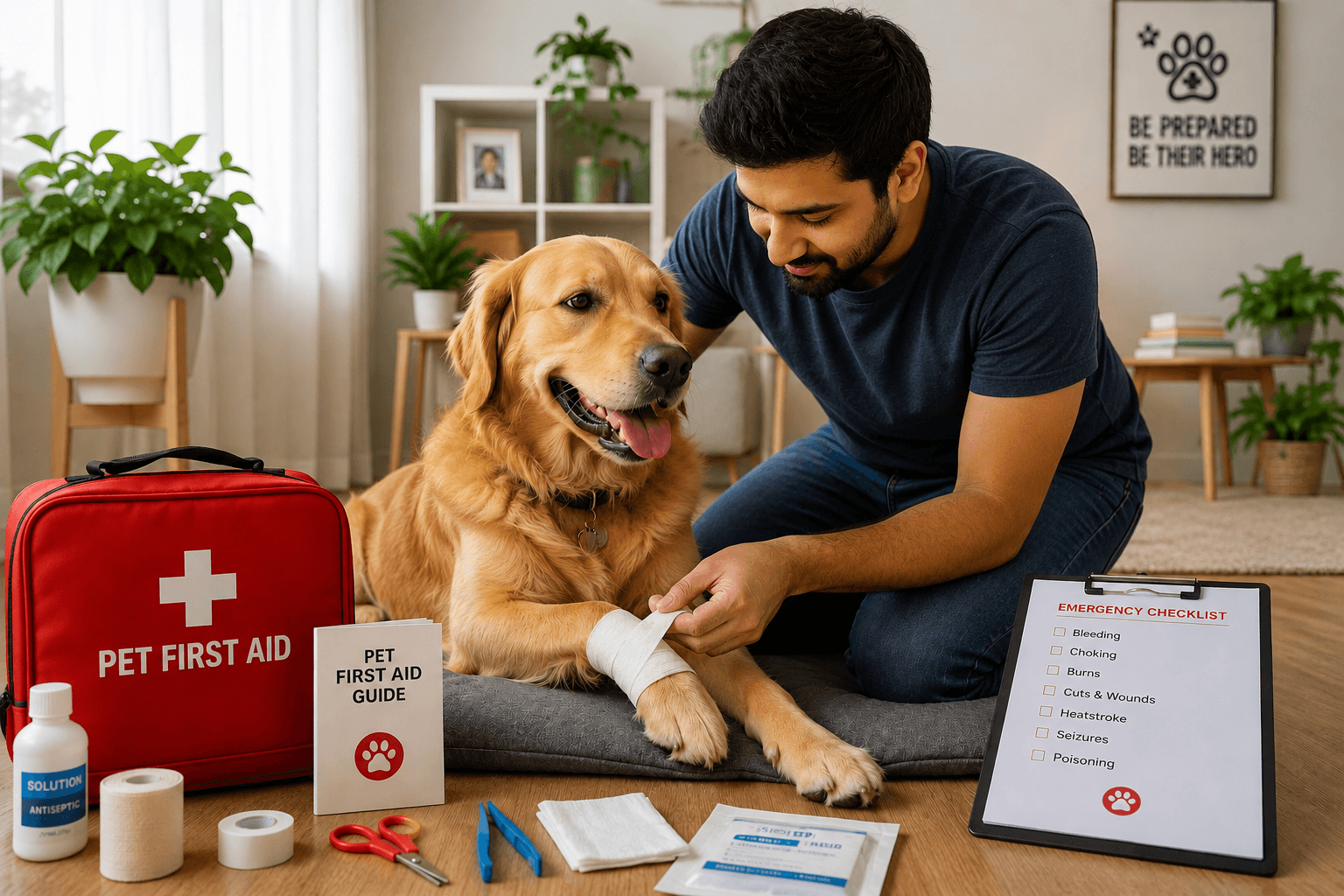
Keep one kit at home and a smaller one in the car or scooter bag. Everything here is easily available at chemists and pet stores.
| Item | Why you need it |
|---|---|
| Sterile gauze pads and cotton roll | Pressing on wounds, padding bandages |
| Self-adhesive (cohesive) bandage roll | Wraps that do not stick to fur |
| Medical tape | Securing gauze |
| Blunt-tip scissors | Cutting bandage or matted fur safely |
| Tick-removal tool or fine-tip tweezers | Ticks are common across India year-round |
| Digital thermometer | Checking for fever or heatstroke |
| Sterile saline (normal saline) | Rinsing wounds and eyes |
| Disposable gloves | Hygiene and your safety |
| Clean towels and an old bedsheet | Wrapping, cooling, or a makeshift stretcher |
| Soft muzzle or a strip of cloth | Prevents bites when moving a hurt dog |
| E-collar (cone) | Stops licking of wounds |
| Torch | Checking mouth, eyes and paws at night |
| Spare leash | A scared dog may bolt |
| Card with phone numbers | Your vet, nearest 24-hour clinic, a family contact |
| Copy of vaccination and medical records | Saves time at an unfamiliar clinic |
Do not stock human painkillers for your dog. Common human medicines like paracetamol and ibuprofen can be toxic to dogs. Only give medicines your vet has prescribed, at the dose your vet sets by weight.
A soft muzzle and a spare leash are worth keeping with the kit.
Dog Bleeding First Aid
Cuts from glass, broken tiles and sharp stones are common on Indian streets.
- Press a clean gauze pad or cloth firmly on the wound.
- Hold steady pressure for at least 3–5 minutes. Do not lift to peek.
- If blood soaks through, add more gauze on top. Do not remove the first layer.
- Wrap with a cohesive bandage: snug, not tight. Toes should stay warm.
- For a bleeding nail, press gauze on the tip until it stops.
- Rinse small, clean scrapes with saline or clean water only.
Go to a vet immediately if the blood spurts, soaks through quickly, does not slow after 5 minutes of pressure, or the wound is deep, gaping, or from an animal bite. Do not use a tight tourniquet at home.
Dog Choking First Aid
Signs: pawing at the mouth, gagging, retching, blue or pale gums, panic, trouble breathing.
- If your dog is still breathing and coughing, keep them calm and go to a vet. Coughing may clear it.
- Open the mouth and look with a torch. If you can clearly see and grip the object, remove it gently.
- Do not push your fingers blindly down the throat. You can push the object deeper.
- If your dog cannot breathe: for a small dog, hold them upside down by the hips and give firm back blows between the shoulder blades. For a large dog, lift the back legs (wheelbarrow-style) and give back blows.
- If that fails, give firm upward thrusts just below the ribcage, then check the mouth again.
Rush to a vet if your dog collapses or stops breathing. Keep trying on the way if someone else can drive.
What to Do If Your Dog Eats Poison
Rat poison, cockroach gel, pesticides sprayed in parks and societies, chocolate, grapes and raisins, onion and garlic gravies, xylitol gum and human medicines are the common culprits in Indian homes.
- Do NOT make your dog vomit unless a vet tells you to. Corrosive products, sharp objects and some poisons cause more damage coming back up. Home remedies like salt water are dangerous.
- Call your vet or nearest 24-hour clinic right away.
- Note what was eaten, how much, and when.
- Take the packet, label or a sample with you.
- Keep your dog calm and go now. Do not wait for symptoms.
Rat poison warning: the common anticoagulant rat poisons often show no signs for a few days, then cause internal bleeding (weakness, pale gums, bruising, blood in urine or stool). If you even suspect your dog ate rat poison, see a vet the same day.
Signs of poisoning: drooling, vomiting, loose motion, shaking, wobbliness, seizures, collapse. Our foods poisonous to dogs in India guide lists the everyday kitchen foods to keep away.
Heatstroke First Aid
Indian summers make this one of the most common dog emergencies. Signs: heavy panting, thick drool, bright red or dark gums, wobbliness, vomiting, collapse.
Researchers at the Royal Veterinary College (UK) advise "cool first, transport second":
- Move your dog into shade or an AC room right away.
- Pour or spray plenty of cool tap water over the whole body, then use a fan or AC so air moves over the wet coat. A conscious dog can also be put in a tub of cool water, keeping the head above water.
- Avoid ice and ice-cold water, and do not leave wet towels draped over the dog. Towels can trap heat.
- Offer small sips of water if your dog is alert. Do not force water.
- Once cooling has started, go to the vet, ideally in an air-conditioned car. Heatstroke can damage organs even after your dog looks better.
Full prevention tips are in our dog summer care and heatstroke guide. In peak summer, a dog walker in Bangalore or a dog walker in Delhi NCR can take your dog out in the cool early-morning hours when you cannot.
Tick Paralysis and Tick Fever
Ticks are a year-round problem in India. Veterinary references list Rhipicephalus and Haemaphysalis, both common on Indian dogs, among the tick types linked to tick paralysis. It is uncommon, but serious.
Signs of tick paralysis: wobbly or weak back legs that spread to the front legs, a change in bark, difficulty swallowing or breathing.
- Search the whole body, especially ears, between toes, armpits, neck and under the collar.
- Remove ticks with a tick tool or fine tweezers. Grip close to the skin and pull out slowly and steadily. Do not squeeze the body or burn it.
- Go to a vet the same day. Paralysis can worsen and affect breathing.
Ticks also spread tick fever (ehrlichiosis and babesiosis): fever, low appetite, pale gums, nosebleeds. See our tick and flea control guide for India.
Snake Bite First Aid for Dogs
Snake bites are a real risk in India, especially in monsoon, near fields, parks and construction sites.
- Keep your dog still and calm. Carry them if you can. Movement spreads venom faster.
- Keep the bitten area at or slightly below heart level.
- Go to a vet immediately and call ahead. Ask if they stock anti-snake venom.
- Do not cut the bite, suck out venom, apply a tight tourniquet, put ice on it, or give human medicines.
- Do not try to catch or kill the snake. A photo from a safe distance helps.
Signs can appear in minutes or be delayed for hours, so go even if your dog seems fine.
Dog Hit by a Car: Road Accident First Aid
- Make sure you are safe from traffic first.
- Approach slowly and speak softly. Use a towel or soft muzzle if the dog is in pain (unless breathing is difficult).
- Do not try to straighten legs or set bones.
- Slide a large dog onto a flat board, a door, or a firmly held bedsheet and carry it as a stretcher. Support a small dog's chest and hips.
- Press on any bleeding wounds.
- Keep the dog warm with a towel and do not give food or water.
Even if your dog gets up and walks, internal bleeding is possible. Every road accident needs a vet check.
Shock, Seizures and Burns
Shock (after injury or heavy bleeding): pale gums, fast breathing, weak pulse, cold paws. Keep your dog warm and quiet and go to a vet urgently.
Seizures: do not hold your dog down or put anything near the mouth. Move furniture away, dim lights, and time it. Go to the vet immediately if it lasts more than 5 minutes or a second seizure follows. A short video helps your vet.
Burns: cool with running cool water for several minutes (about 15 minutes for chemical burns, avoiding the eyes). Do not apply butter, oil, ghee or toothpaste. Cover loosely with a clean cloth and see a vet.
When to Rush to a Vet Immediately
Go now, do not wait and watch, if your dog has:
- Trouble breathing, choking, or blue, white or very pale gums
- Collapse, fainting or cannot stand
- A seizure lasting more than 5 minutes, or repeated seizures
- Suspected poisoning, even with no symptoms yet
- Bleeding that does not slow after 5 minutes of pressure
- A road accident, fall from height, or snake bite
- Signs of heatstroke
- A swollen, hard belly with retching but nothing coming up (possible bloat, common in large deep-chested breeds)
- Straining to urinate with little or no urine
- Wobbly back legs that are getting worse
- Repeated vomiting or bloody diarrhoea, especially in puppies
Emergency Vet Near Me: Be Ready Before It Happens
- Search "24 hour vet" on Google Maps now and save two clinics near your home in your phone.
- Ask your regular vet what to do after hours.
- In several states, including Karnataka, Telangana, Tamil Nadu, Uttar Pradesh and Rajasthan, dialling 1962 reaches government mobile veterinary units. These are mainly set up for livestock and hours vary, so treat them as a backup, not your first call.
- Keep your dog's records and a leash near the door.
- Consider a hands-on pet first aid or CPR course. CPR is hard to learn from an article.
If you travel often, leave your sitter or boarder a copy of your vet's number. When booking dog boarding in Bangalore or pet sitting in Delhi NCR, ask the provider about their emergency plan.
Frequently Asked Questions
What is pet first aid?
Pet first aid is the immediate care you give an injured or sick pet to keep them safe and stable until a vet can treat them. It does not replace a vet visit.
What should be in a dog first aid kit in India?
Gauze, cohesive bandage, tape, blunt scissors, a tick remover, digital thermometer, saline, gloves, towels, a soft muzzle, an e-collar, a torch, and your vet's and 24-hour clinic's numbers.
What to do if my dog eats poison?
Call your vet or nearest 24-hour clinic right away and go in with the packet. Do not make your dog vomit unless a vet tells you to.
Should I make my dog vomit after eating something toxic?
No, not unless a vet advises it. Some poisons and sharp objects cause more damage coming back up, and home remedies like salt water can be dangerous.
How do I stop my dog's bleeding?
Press a clean cloth firmly on the wound and hold for 3–5 minutes without lifting. If it spurts or will not slow down, go to a vet immediately.
What do I do if my dog is choking?
Look in the mouth and remove the object only if you can clearly see and grip it. If your dog cannot breathe, give back blows and then upward thrusts below the ribs, and head to a vet.
What should I do if a snake bites my dog?
Keep your dog still, carry them, and go to a vet at once. Do not cut, suck, tie a tourniquet or apply ice.
My dog was hit by a car but seems fine. Should I see a vet?
Yes. Internal bleeding and injuries are not always visible. Every road accident needs a vet check.
Can I give my dog paracetamol for pain?
No. Paracetamol, ibuprofen and many human medicines can be toxic to dogs. Only give what your vet prescribes, dosed by weight.
What is the emergency number for animals in India?
There is no single national pet emergency number. Several states use 1962 for government mobile veterinary units, mostly for livestock. Save your nearest 24-hour vet clinic's number as your main contact.
Final Thought
Most dog parents will never need half of this guide. But knowing the basics turns panic into action. Save your vet's number, build a small kit this week, and share this page with whoever looks after your dog.
For more new-parent basics, read our first-time dog owner guide and the dog deworming schedule for India.
This guide is for general awareness and is not a substitute for veterinary care. In an emergency, contact your vet or nearest 24-hour clinic straight away.
Sources: Royal Veterinary College VetCompass heatstroke guidance ("cool first, transport second"); VCA Animal Hospitals and Cornell University College of Veterinary Medicine on heatstroke; Merck Veterinary Manual on tick paralysis; VIN Veterinary Partner and Oklahoma State University Extension on snake bites in pets; ASPCA Animal Poison Control on toxic human foods and medicines; Deccan Herald and Vikaspedia on state 1962 mobile veterinary helplines.
Share this article
Ready to Find Pet Services Near You?
Browse verified pet service providers in your city and book instantly on wagNbush.